
 whatsapp


WELCOME TO ECO HOUSE !WELCOME TO ECO HOUSE !WELCOME TO ECO HOUSE !




News
28/12/25
PVC Windows for Children’s Rooms: Safety, Ventilation, Design
Choosing windows for a child’s room involves three critical aspects: child safety, healthy indoor climate, and aesthetic appeal. Let’s explore how PVC windows can meet all these requirements.
1. Safety: Preventing Accidental Opening
The primary goal is to eliminate the risk of falls and injuries. Modern PVC systems offer several layers of protection:
- Lockable handles. Integrated into standard hardware — only open with a key. Ideal for constant supervision.
- Opening restrictors. Mounted on the sash, they allow:
- locking the window in a «ventilation» mode (5–10 mm gap);
- completely blocking full opening.
- Safety grilles. Vertical or horizontal bars spaced 10–12 cm apart:
- don’t obstruct the view;
- prevent falls.
- Important: must be fixed to the frame, not the wall.
- Impact‑resistant glass. Laminated (triplex) or tempered glass:
- doesn’t produce sharp shards if broken.
Tip: Combine solutions. For example, a lockable handle + restrictor provides double protection if a child finds the key.
2. Ventilation: Fresh Air Without Drafts
Healthy air circulation without overcooling is crucial for children. Optimal solutions:
- Micro‑ventilation mode. The sash moves 2–5 mm away from the frame:
- ensures constant fresh air flow;
- eliminates drafts;
- prevents condensation.
- Ventilation valves. Installed in the upper frame:
- regulate airflow (manual or automatic control);
- work even when the window is closed;
- maintain sound insulation.
- Humidity‑controlled systems. Automatically open the valve when humidity rises (e.g., during play or sleep).
Important: Avoid tilt‑first ventilation — children can reach the open sash.
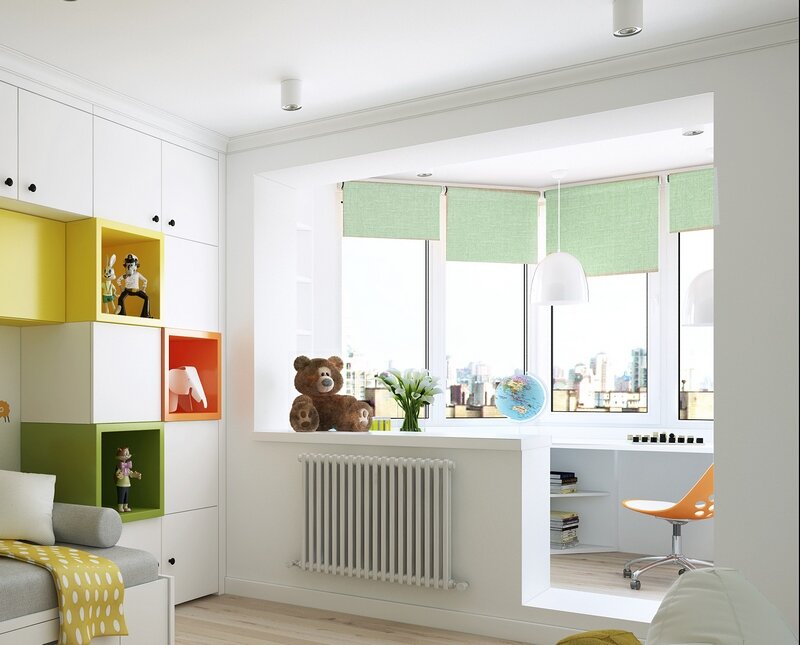
3. Design: Integrating the Window into the Child’s Space
A child’s window isn’t just an opening — it’s part of the interior. Creative options:
- Vibrant colours. PVC profile lamination in bold shades:
- blue, green, yellow — universal choices;
- two‑tone designs (neutral outside, bright inside).
- Unusual shapes. Arched, triangular, or trapezoidal windows:
- add personality to the space;
- fit thematic designs (e.g., «house» or «ship»).
- Decorative grilles. Muntins (internal or external bars) create patterns on glass:
- geometric shapes;
- faux stained‑glass effects.
- Glass decals. Matte or coloured films with child‑friendly motifs:
- animals, clouds, stars.
Tip: Choose matte surfaces — they reduce glare and don’t strain the eyes.
What to Consider When Ordering
- Material certification. Ensure PVC and seals don’t emit harmful substances (look for EN 12608 or equivalent markings).
- Sound insulation. For rooms facing busy streets, choose glass units with a sound reduction index ≥ 32 dB.
- Easy maintenance. Smooth profile and glass surfaces simplify cleaning after children’s activities.
- Warranty. Prioritise manufacturers offering ≥ 5 years warranty on hardware.
Conclusion
Safe and comfortable PVC windows for children’s rooms include:
- multi‑layered opening protection (lockable handles + restrictors);
- smart ventilation (micro‑ventilation or valves);
- design that supports a playful atmosphere (colours, shapes, decor).
By combining these elements, you’ll create a space where children feel secure and parents can relax.
What windows do you like the best?
Which kind of windows would you prefer If you were going to replace the old ones in your house or apartment?
Eco House Joint Stock Company partner of Deceuninck Group | Copyright 2009-2026. All rights reserved.
E-mail: info@ecohouse-eg.com, tel.: +201212288828
Site www.ecohouse-eg.com is for informational purposes only and under no circumstances is not a public offer. For more information on the cost of materials, products and services, please contact the sales offices