
News
25/10/26
Round Windows: From Ancient Castle to Modern House
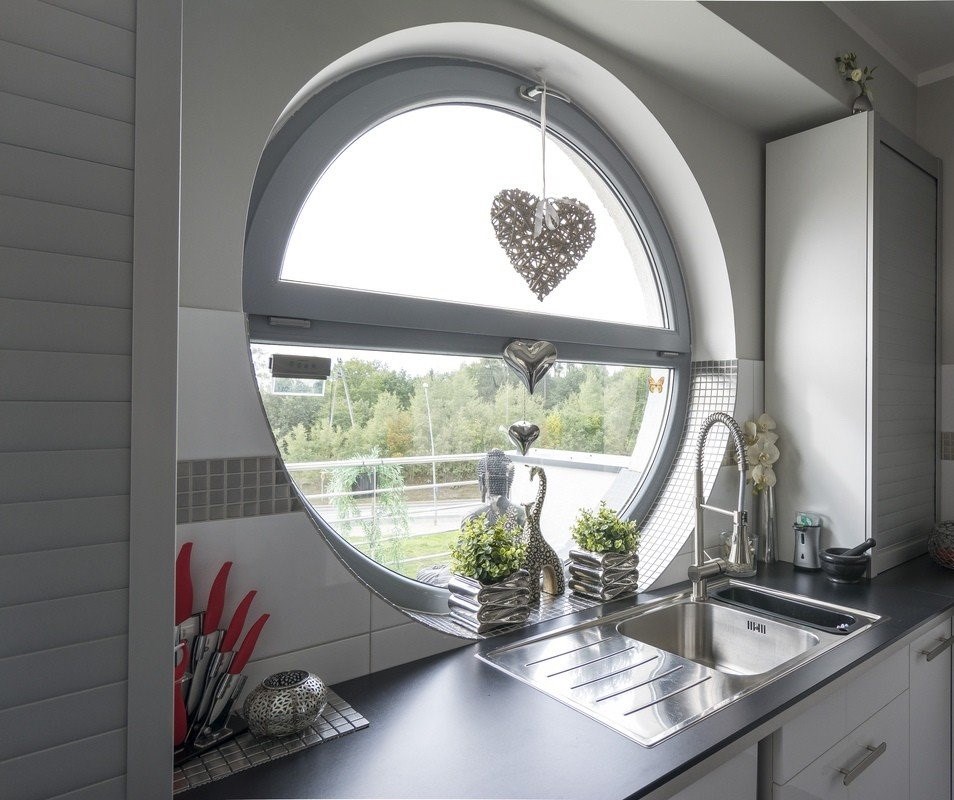
The circle is one of the most harmonious shapes, and round windows immediately draw the eye on a facade. They evoke images of ship portholes, old castle towers, and cozy attics, and in a modern home they become a bold stylistic detail.
Round windows work best in specific locations. In a bathroom or shower room, they provide gentle lighting and an intriguing view while preserving privacy. In an attic or on a staircase, a round window acts as a light accent, adding dynamism to the space. In a child’s room, a round window can be part of a playful theme — for example, a “pilot’s cockpit” or a “spaceship”.
Technically, round PVC windows are more complex than rectangular ones: the profile is bent to a radius, and the glazing unit is made using a special method to maintain airtightness and thermal insulation. Because of this, not all round windows can be opening units: small models are often made fixed, while larger ones have hinged or tilt‑and‑turn sashes designed to fit naturally into the round frame.
In the interior, a circle pairs well with rounded details: arched niches, soft furniture shapes, and wavy patterns in textiles. Wood‑grain lamination gives the window a warm, homely feel, while a solid colour in a contrasting shade makes it a graphic focal point. Tinted or stained glass adds depth: a semi‑transparent pattern gently diffuses the light, creating an intimate atmosphere in the room.
When planning a round window, practical aspects also matter. First, curtains and blinds for a round shape must be custom‑made: roller systems, pleated shades, or decorative panels work best because they follow the contour. Second, accessing the exterior for cleaning can be difficult, so it’s worth thinking ahead about a convenient maintenance solution. Finally, proportions are important: a window that’s too small gets lost, while one that’s too large can overwhelm the facade. A diameter of 60 to 120 cm is usually optimal, depending on the wall’s scale and the size of nearby openings.
uPVC Windows and Doors in Egypt. Any color of turn, tilt and turn, tilt sliding, sliding, parallel sliding system, arched non standard PVC windows. Mosquito nets, roller and lower shutter, jalousie in double glass or triple glazing by Super Spacer technology. Painted and bend uPVC profile, stained glass. Painting and bending PVC profile WINSA Carina, Vela. Maintenance and Repairing
Eco House Joint Stock Company partner of Deceuninck Group | Copyright 2009-2026. All rights reserved.
E-mail: info@ecohouse-eg.com, tel.: +201212288828
Site www.ecohouse-eg.com is for informational purposes only and under no circumstances is not a public offer. For more information on the cost of materials, products and services, please contact the sales offices
