
News
01/08/26
Triangular PVC Windows: Geometry of Style and Light
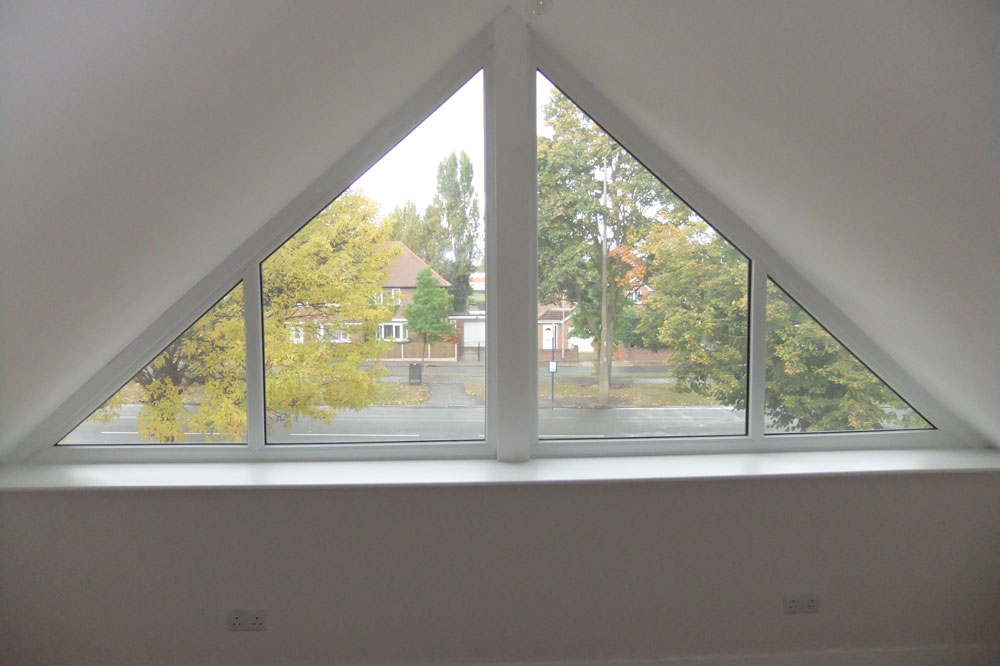
Triangular PVC windows are a striking detail in a home’s architecture: their strict geometry adds dynamism to the facade and gives the interior a distinctive character. These windows are most often chosen for attics, dormer openings, and rooms under pitched roofs. They fit perfectly into roof slopes, make the most of the space, and provide plenty of natural light even in compact rooms.
Manufacturing triangular windows requires a special approach. The profile is cut and welded at precise angles, and a steel reinforcing insert is always installed inside the frame — it prevents the structure from deforming and maintains its rigidity. The minimum angle at the joint is usually not made smaller than 30°: with sharper joints, the weld strength drops, making the window more vulnerable to loads. For glazing, durable glazing units are used — often with triplex or tempered glass. This is safer, especially if the window is located high up or in an area with active movement.
Functionally, triangular windows come in different types: fixed ones for a purely decorative effect and maximum light, or ones with an opening sash. The opening mechanism depends on the shape: for example, a right‑angled triangle works well with a hinged opening along the vertical side, while an isosceles triangle suits a transom or tilt‑only option. Sometimes a large unit is divided into sections with mullions — this increases strength and allows only part of the window to be movable.
Installation is also quite challenging: the opening must be perfectly prepared, and the frame must fit flawlessly, otherwise airtightness and thermal insulation will suffer. But the result is impressive: a triangular window becomes a focal point that draws the eye and makes the space truly special.
uPVC Windows and Doors in Egypt. Any color of turn, tilt and turn, tilt sliding, sliding, parallel sliding system, arched non standard PVC windows. Mosquito nets, roller and lower shutter, jalousie in double glass or triple glazing by Super Spacer technology. Painted and bend uPVC profile, stained glass. Painting and bending PVC profile WINSA Carina, Vela. Maintenance and Repairing
Eco House Joint Stock Company partner of Deceuninck Group | Copyright 2009-2026. All rights reserved.
E-mail: info@ecohouse-eg.com, tel.: +201212288828
Site www.ecohouse-eg.com is for informational purposes only and under no circumstances is not a public offer. For more information on the cost of materials, products and services, please contact the sales offices
