
News
25/11/26
Black accent for PVC windows: night-colored curtains
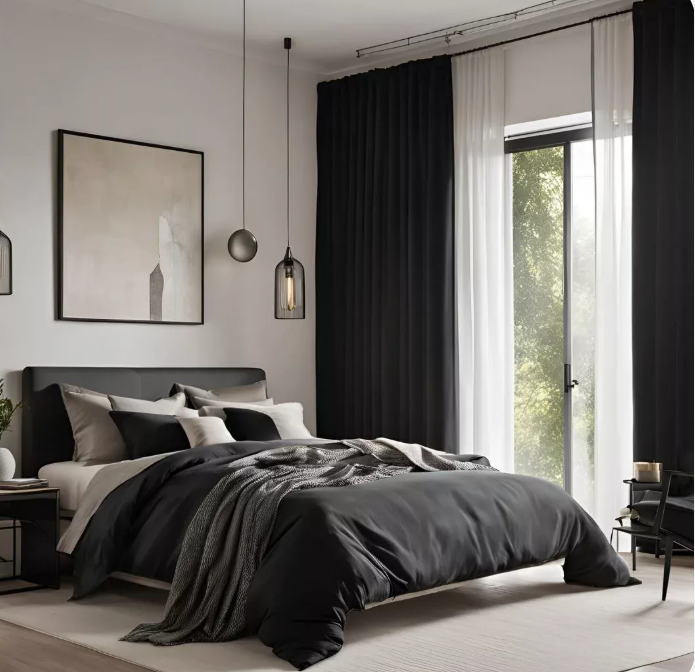
Black curtains are a decision for the fearless — which is exactly why it's so striking. A PVC window framed in graphic black textiles stops being a functional element and becomes an art object: against dark fabric, the white plastic frame looks like an engraving in a mat.
Black textiles are a tool of professional designers, and here's how they work. First, they add contrast and composure to an interior: a room with black accents always looks deliberate. Second, they visually "anchor" the window in space — a pale wall stops dissolving, and the composition gains a point of support. Third, black is the champion of drama: dense black blackout curtains in the bedroom create absolute darkness that light-sensitive people can only dream of.
What to pair it with? With white — the timeless monochrome classic, Scandinavian loft in its purest form. With wood and brass — warm, "hotel-style" elegance. With terracotta and mustard — a bold contemporary mix. With emerald — the deep luxury of old libraries. And in a grey room, a single black element at the windows supplies the missing accents.
Don't overdo it: black at the window is like truffle in a dessert — there should be little of it, and it must be high quality. Cheap glossy fabric instantly cheapens the whole interior, so choose matte textures — linen, dense cotton, velvet with a soft, deep sheen.
There's a psychological nuance, too: in small, dark rooms, fully black curtains can feel oppressive. The compromise is black in the lower part of the composition, curtains with a lining, or a black curtain rod paired with a light charcoal textile.
Black textiles are for those tired of "safe" interiors. They don't ask for permission — they simply make the room feel grown-up.
uPVC Windows and Doors in Egypt. Any color of turn, tilt and turn, tilt sliding, sliding, parallel sliding system, arched non standard PVC windows. Mosquito nets, roller and lower shutter, jalousie in double glass or triple glazing by Super Spacer technology. Painted and bend uPVC profile, stained glass. Painting and bending PVC profile WINSA Carina, Vela. Maintenance and Repairing
Eco House Joint Stock Company partner of Deceuninck Group | Copyright 2009-2026. All rights reserved.
E-mail: info@ecohouse-eg.com, tel.: +201212288828
Site www.ecohouse-eg.com is for informational purposes only and under no circumstances is not a public offer. For more information on the cost of materials, products and services, please contact the sales offices
