
News
09/09/26
Not Just Wide Open: How to Ventilate PVC Windows Properly
PVC windows provide excellent protection from cold and noise, but without proper ventilation, the room quickly becomes stuffy, humidity rises, and there’s a risk of condensation. Fortunately, modern windows offer various ways to ensure a flow of fresh air without sacrificing comfort.
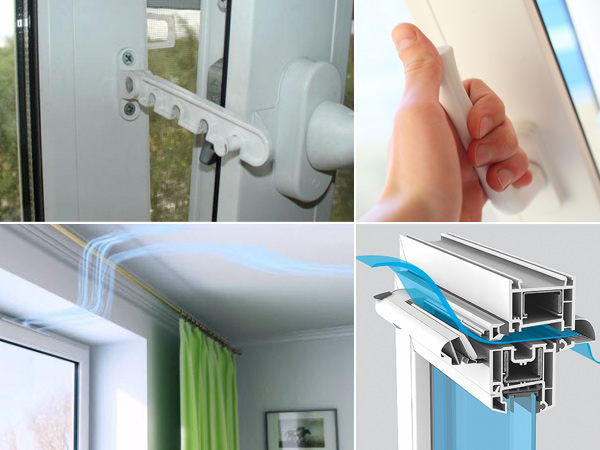
The simplest option is to open the sash fully. This provides maximum air exchange, but it’s only suitable in warm, windless weather: in winter, this method leads to sharp temperature fluctuations and heat loss. A partial solution is the micro‑ventilation mode: when you turn the handle to a certain angle, the sash moves away from the frame by a couple of millimetres. This lets air into the room while keeping draughts to a minimum.
Another convenient option is built‑in intake vents. They’re installed in the upper part of the frame or sash, delivering air in controlled amounts, filtering out dust, and working regardless of whether the sash is closed. Some models allow you to adjust the airflow intensity.
For more precise control, window restrictors (“comb” locks) are used — they fix the sash in several positions, letting you choose a comfortable gap. In more complex cases, wall‑mounted vents or compact air purifiers (breathers) help: they not only supply air but also heat it, and some even clean it.
Proper ventilation is all about balancing fresh air and heat retention. When choosing a method, consider the climate, floor level, street noise, and the room’s features. This way, PVC windows will be not only airtight but also truly comfortable.
uPVC Windows and Doors in Egypt. Any color of turn, tilt and turn, tilt sliding, sliding, parallel sliding system, arched non standard PVC windows. Mosquito nets, roller and lower shutter, jalousie in double glass or triple glazing by Super Spacer technology. Painted and bend uPVC profile, stained glass. Painting and bending PVC profile WINSA Carina, Vela. Maintenance and Repairing
Eco House Joint Stock Company partner of Deceuninck Group | Copyright 2009-2026. All rights reserved.
E-mail: info@ecohouse-eg.com, tel.: +201212288828
Site www.ecohouse-eg.com is for informational purposes only and under no circumstances is not a public offer. For more information on the cost of materials, products and services, please contact the sales offices
