
News
09/01/26
How PVC Windows Are Manufactured: A Brief Overview
Manufacturing plastic windows is a multi‑stage process that requires precise equipment and strict quality control. Below are the key stages from measurement to the finished product.
1. Measurement and Design
A specialist takes precise measurements of the window opening. Based on these data, a drawing and specification are created, indicating the profile parameters, hardware type, and glass unit dimensions. The data are entered into software that calculates the components and generates a production order.
2. Profile Cutting
The PVC profile is cut into blanks at a 45° angle using a high‑precision circular saw. The accuracy of the cut directly affects the quality of subsequent component joining.
3. Reinforcement
The hollow PVC profile is strengthened with a metal rod (U‑shaped or rectangular). The reinforcement adds rigidity and prevents deformation due to temperature fluctuations. It is cut to size, cleaned, and secured with self‑tapping screws at approximately 300 mm intervals.
4. Milling
Using a machine, the following are created:
- mounting holes for hardware and fasteners;
- drainage channels for condensate removal;
- holes for the handle and lock (per standard or customer request).
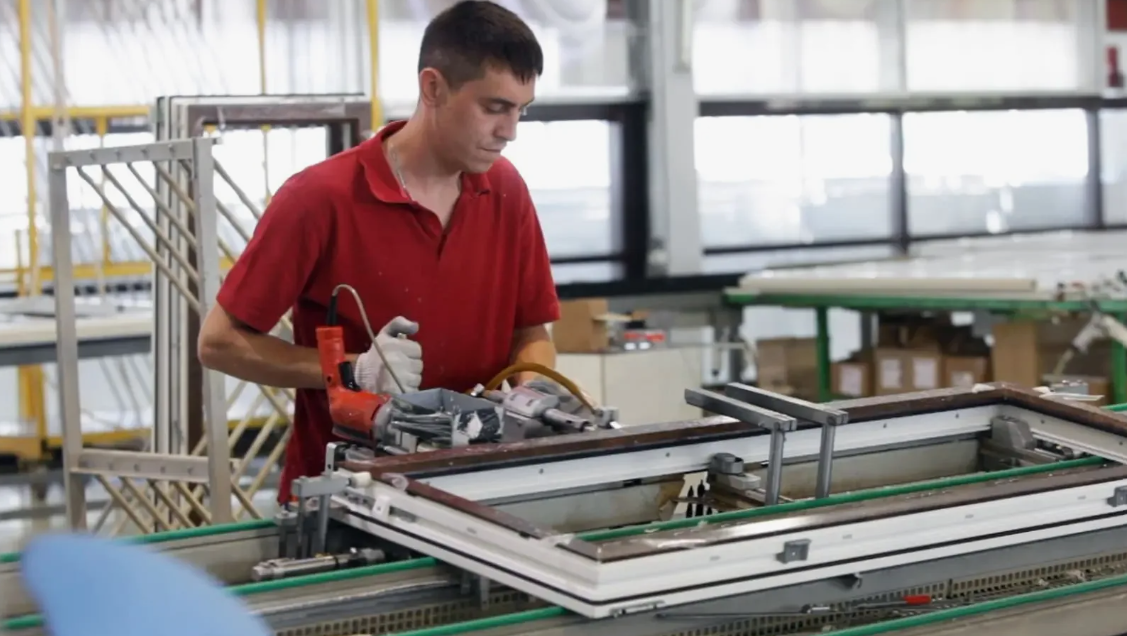
5. Profile Welding
Reinforced blanks are joined on an automatic welding machine. The ends are heated to melting temperature, pressed tightly together, and held under pressure until cooled. Modern machines can weld all four corners simultaneously, ensuring perfect frame geometry.
6. Seam Cleaning
Welded joints are ground using computer‑controlled equipment to remove excess PVC and smooth the surface.
7. Assembly and Hardware Installation
- An impost (vertical partition) is installed in the frame if required by the design.
- Hardware is mounted: hinges, handles, locks, safety devices, and ventilation inserts.
- Elastomer seals are glued in place to ensure tight sealing between sashes and the glass unit.
- Sashes are hung on hinges; fasteners are concealed with plastic covers.
8. Glass Unit Installation
The glass unit is placed into the frame and secured with glazing beads that fit into the profile grooves. Position is adjusted using a mallet. Seal integrity is checked visually and manually.
9. Quality Control
The finished window is tested for:
- ease of sash movement;
- tight seal and absence of air leaks;
- proper hardware operation;
- dimensional accuracy.
If necessary, mechanisms are adjusted.
10. Final Processing and Packaging
The window unit is cleaned of dust and residual materials; decorative film is applied if required. The finished product is packaged for transportation.
Important: window quality depends on:
- accuracy of measurements and design;
- quality of profile and reinforcement;
- automation of key operations (cutting, welding, milling);
- quality control at every stage.
Therefore, it is advisable to choose manufacturers with certified production facilities and product warranties.
uPVC Windows and Doors in Egypt. Any color of turn, tilt and turn, tilt sliding, sliding, parallel sliding system, arched non standard PVC windows. Mosquito nets, roller and lower shutter, jalousie in double glass or triple glazing by Super Spacer technology. Painted and bend uPVC profile, stained glass. Painting and bending PVC profile WINSA Carina, Vela. Maintenance and Repairing
Eco House Joint Stock Company partner of Deceuninck Group | Copyright 2009-2026. All rights reserved.
E-mail: info@ecohouse-eg.com, tel.: +201212288828
Site www.ecohouse-eg.com is for informational purposes only and under no circumstances is not a public offer. For more information on the cost of materials, products and services, please contact the sales offices
